
Just a year ago, outrage focused on RTX 50-series cards priced between $819 and $2,400. Those figures now seem almost quaint, relics of a more reasonable era.
Today, an Asus ROG Matrix Platinum GeForce RTX 5090 appeared on Newegg for $7,499. The sheer magnitude of the price is staggering, a stark illustration of how dramatically the market has shifted.
While the $7,499 listing comes from an independent vendor, it’s the broader trend that’s alarming. Most RTX 5090 cards currently sell for around $4,000, with Amazon mirroring similar inflated prices.
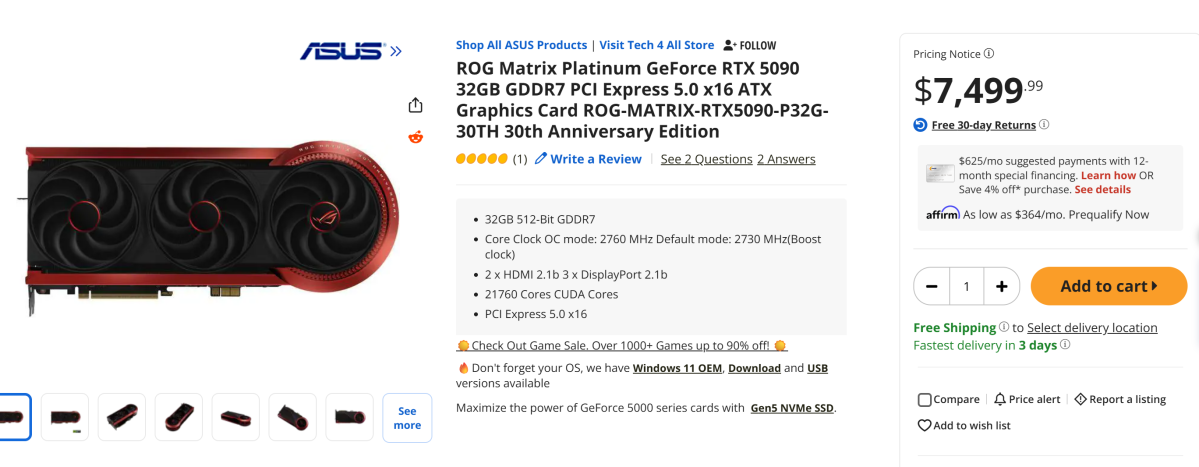
It’s a breathtaking escalation. Complaints about $2,400 RTX 5090 cards – a mere $400 over the suggested retail price – now feel like distant memories. Prices have surged with the unpredictable velocity of a speculative asset.
Data shows the RTX 5090 averaged around $2,000 in January 2025, roughly the cost of a high-end laptop. That price has doubled in just over a year, and acceptance of this new normal is unsettling.
The RTX 5080 offers a slightly less painful hit to the wallet, around $1,500, while the RTX 5070 is “only” $650 for a model with 12GB of RAM. However, upgrading to 16GB on the 5070 pushes the price to around $1,100.
These prices aren’t just numbers; they’re a crushing weight on consumers. They fundamentally alter the economics of building or buying a PC, impacting recommendations and shifting the entire landscape of comparative value.
Last Black Friday, analysts suggested bundling components to mitigate the price increases. Retailers are more willing to absorb losses across a package, especially when software or license costs are involved.
Prebuilt PCs offer another potential workaround, essentially functioning as pre-packaged bundles. Opting for a less powerful GPU, like an RTX 5060, can bring the overall cost down, as seen with a recent $1,219 Newegg desktop.
However, even these prebuilt solutions are likely to become more expensive. The ongoing AI-driven RAM shortages are predicted to last for years, a forecast that no longer feels hyperbolic.
The situation is almost unbelievable. It’s March 2026, and a high-end graphics card now costs as much as a used car. And the trajectory points to further increases, not relief.


