Travel, at its heart, is food for the soul. It’s a vibrant feast for the senses, a deeply restorative experience that transcends the everyday. This idea resonated with me after encountering the teachings of Georges Gurdjieff, a mystic who believed our sensory impressions provide vital energy and nourishment.
While not easily quantified, the truth of this notion is powerfully evident with every journey I undertake. The energy I absorb while traveling is palpable, a tangible shift in my very being. I become a different person, revitalized and awakened, compared to the stagnation that creeps in after too much time spent within familiar walls.
That promise of renewal – that surge of life – is a compelling motivation to break free from routine and venture into Europe. There, a richly layered tapestry of cultural impressions awaits, operating on countless levels simultaneously. These impressions collectively infuse you with new energy, broaden your perspective, and enhance your capacity for joy.
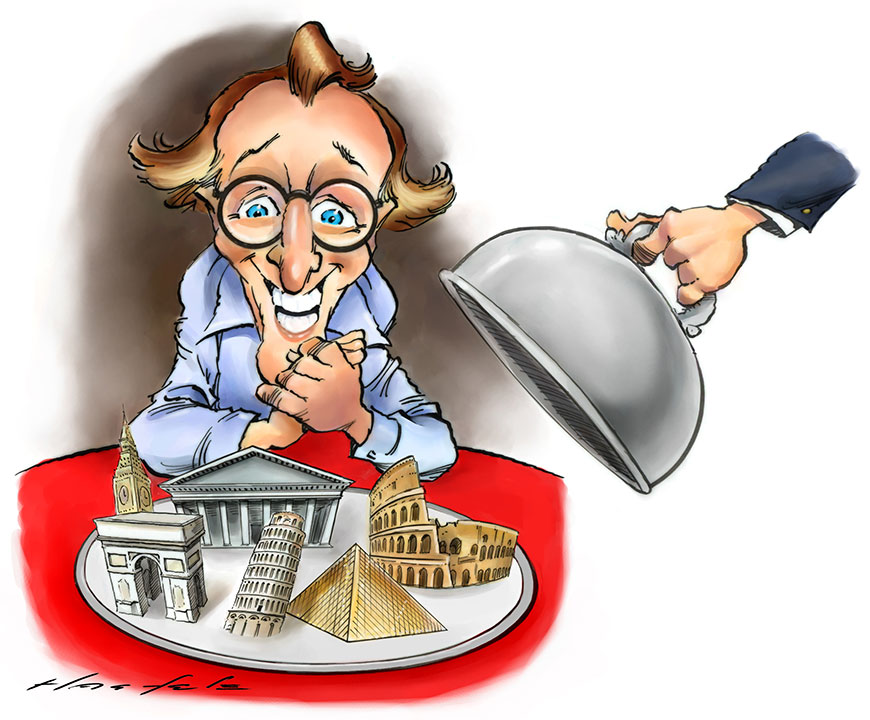
This process unfolds repeatedly in my life, and likely in yours as well. We all experience periods of staleness, where familiar routines lose their resonance. When life becomes a cycle of habit, experiences yield diminishing returns, becoming less rewarding until a fresh perspective is desperately needed.
It’s then that we must seek the unknown, embark on new paths, and expand our world. True discovery only happens beyond the boundaries of the familiar. And for a place brimming with enriching impressions, Europe stands unrivaled, offering an unparalleled density of experience within a relatively small space.
For those fascinated by American history, Europe is the wellspring from which our nation’s story began. While Early America was taking shape in the 1600s and 1700s, European civilization had already flourished for a millennium, built upon the foundations of the Roman Empire. The cultural richness of Europe originates with Rome itself.
The very fabric of American culture was initially woven from European threads – French influence in the north, British in the original colonies, Spanish in the south. While enriched by Native American, African, and Asian influences, the foundational culture of the colonies was undeniably European. Tracing our roots inevitably leads back to the mother countries.
In Europe, you can witness and feel a thousand years of history that predates the colonization of the Americas. The last two millennia are layered upon each other like geological strata, a tangible weight of the past. It’s an experience that transcends reading or watching videos; some history is absorbed viscerally, a feeling that words and images simply cannot capture.
Early Americans aspired to build upon European culture, and that aspiration remains valid today. Europe isn’t merely a historical treasure trove; it’s a vibrant, evolving region, constantly adapting and innovating. It’s captivating to observe how different countries and cultures embrace and develop each wave of technological and stylistic change.
Europe remains remarkably concentrated in its diversity, offering an astonishing variety of cultures within a relatively small area – a space smaller than India. From the glory of Rome to the distinct nations that emerged in the two thousand years since, the richness and variety are truly exceptional. The echoes of Rome resonate throughout the continent, even in the British Isles.
Ralph Waldo Emerson eloquently captured this enduring Roman influence: “The Roman conquest carried its arts and roads as far as the Thames…it built a wall, and presently the world receded from its feet.” Rome laid the foundation for European civilization, and a magnificent tapestry of cultures has grown from that ancient seed.
Much of that history is preserved within the very fabric of Europe, visible in the street layouts of modern cities like Rome, where ancient Roman roads still guide contemporary traffic. The Pantheon, built in 125 A.D., stands at the heart of modern Rome, a testament to enduring architectural brilliance.
It exists alongside structures from countless eras – Medieval, Renaissance, Baroque, Neoclassical, and Modern – a breathtaking juxtaposition of time. Since 609 CE, it has served as a Catholic church. To gaze upon it is to glimpse another dimension, as if viewing the past through the wrong end of a telescope.
The Pantheon seems to vibrate at a different frequency, standing apart from its surroundings. It’s just one striking example of the historical juxtapositions you encounter with every step you take across Europe. These layers of time, these echoes of the past, are what make the continent so profoundly captivating.
Each time I break free from routine and travel, I rediscover a fundamental truth: travel unleashes a tremendous amount of energy, a vitality that was dormant before departure. The source of this energy is less important than the fact that it exists, a powerful boost that lingers long after returning home, making the familiar feel new again.