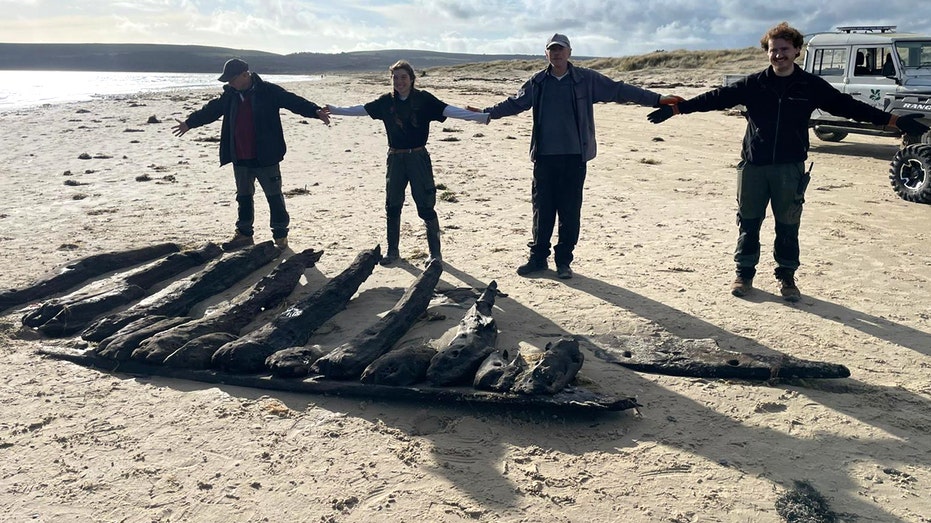
The relentless fury of winter storms along the Dorset coast of England has unveiled a secret held by the sea for centuries. A ghostly silhouette of a 17th-century ship has emerged from the sands of Studland Beach, a breathtaking reminder of a bygone era.
Experts believe this resurrected vessel is “The Fame,” a Dutch merchant ship hailing from Hoorn, Netherlands. In 1631, a treacherous sandbank near Poole Harbor sealed its fate, breaking its back and forcing its 45-member crew to abandon ship – thankfully, all survived.
The exposed timbers, stretching nearly 20 feet in length and 6.5 feet wide, reveal a remarkable level of preservation. Fifteen frames, connected by ancient wooden treenails, still cling to five outer hull planks, a testament to the skill of 17th-century shipwrights.
Interestingly, the outer planks have endured remarkably well, while the inner layers and the frames themselves show signs of erosion. This is explained by the ship’s intermittent exposure over the decades, with the outer hull shielded by the protective embrace of the sand.
Though recently revealed, the wreck wasn’t unknown. It was first identified in the 1990s within the Swash Channel. A 2013 excavation noted missing sections, and the current exposure suggests those very pieces have now been found by the shifting sands.
“The Fame” wasn’t merely a cargo carrier; it was a formidable vessel capable of mounting over 40 guns. This firepower was essential for defending against the ever-present threat of pirates during voyages to the Caribbean, where it would return laden with valuable salt.
Local accounts paint a vivid picture of the aftermath of the grounding. While the crew escaped unharmed, opportunistic residents quickly descended upon the wreck, eager to salvage whatever treasures they could find.
Tracey Churcher, of the National Trust, described the discovery as “a real treasure,” marveling at the enduring strength of the wooden treenails that have held firm for 400 years – a powerful tribute to the craftsmanship of the past.
An upcoming excavation promises to unlock further secrets of the ship. Fleur Castell, a National Trust spokesperson, emphasized the dynamic nature of the coastline, noting that the area now forming the beach was once open sea four centuries ago.
The shifting sands and powerful storms are accelerating coastal changes, exposing fragile sections of the wreck. Officials are urging visitors to respect the site and refrain from touching or disturbing the exposed timbers, ensuring its preservation for future study.
Maritime archaeologist Tom Cousins is currently overseeing the site’s protection. Dendrochronology testing is planned, a meticulous process that will hopefully pinpoint the ship’s exact age and definitively confirm its identity as “The Fame.”
This remarkable find joins a growing list of significant maritime discoveries made in recent years, including the identification of two slave ships off the coast of Central America and a centuries-old vessel unearthed beneath a Spanish fish market – each a poignant window into our shared history.