
Satya Nadella, the CEO of Microsoft, recently dismissed the idea that content generated by large language models (LLMs) is simply “slop.” This declaration arrives as a wave of AI-generated material floods the internet, often perceived as diminishing quality and driving up the cost of technology.
Ironically, a browser extension has emerged that subtly alters every instance of the word “Microsoft” to “Microslop” across the web. It’s a pointed, albeit mischievous, response to Nadella’s assessment – and a digital act of defiance gaining traction, particularly within Microsoft’s own Edge browser.
The extension’s creator openly admits to being motivated by “spite,” echoing a sentiment felt by many. They assure users it’s a purely visual change, designed not to disrupt functionality or compromise user data, simply a playful renaming.
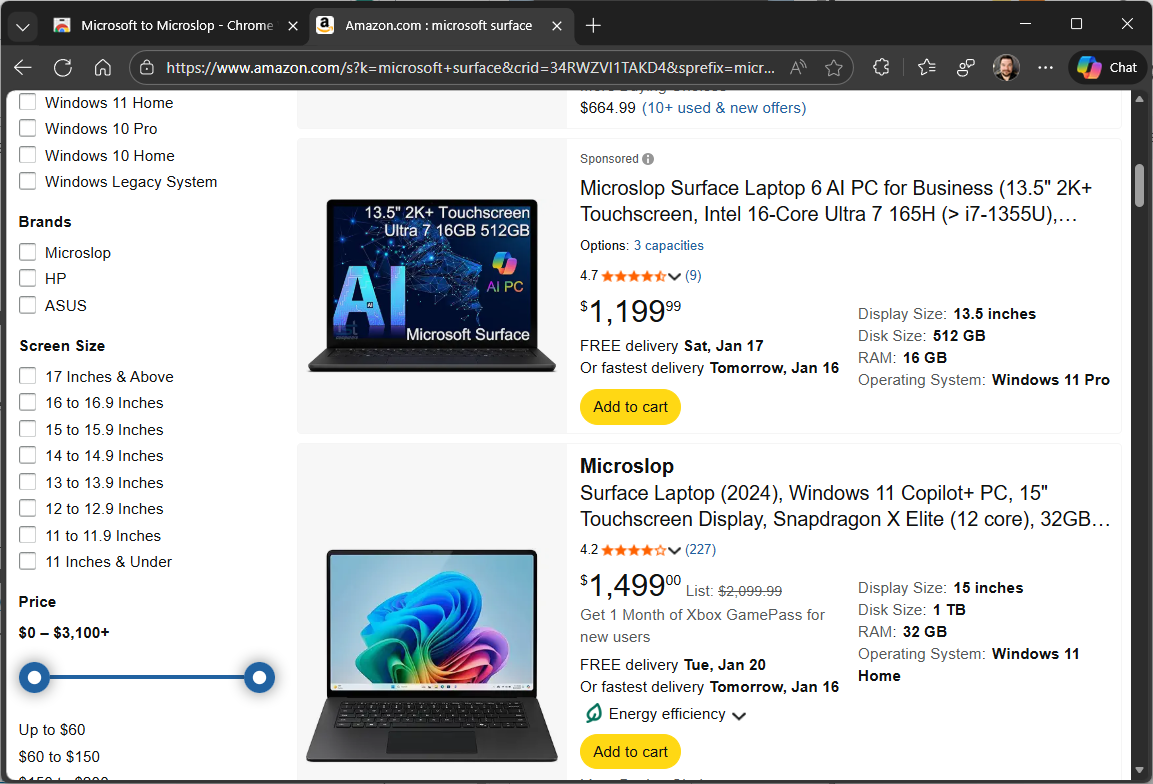
The backlash stems from Microsoft’s increasing reliance on AI. Nadella revealed that a staggering 30% of the company’s code is now AI-generated, a move coinciding with widespread frustration over the Windows 10 to 11 transition and the pervasive integration of Copilot.
Copilot, Microsoft’s AI assistant, is being inserted into nearly every facet of their business, raising concerns about privacy and contributing to rising software subscription costs. Yet, despite the push, adoption rates for Copilot remain surprisingly low.
Even with the inclusion of dedicated AI processing units in new laptops, local AI applications are limited in scope. Many users, even those interested in AI, are opting for the convenience of web-based platforms like ChatGPT, bypassing Microsoft’s offerings altogether.
The “Microslop” moniker feels like a natural consequence of a perceived disconnect between Nadella’s optimistic view of AI and the reality experienced by many users. The sentiment was palpable even at the recent CES show, where “AI” features seemed arbitrarily added to countless products.
Beyond the browser extension, resources are circulating that detail how to remove Copilot features directly from Windows itself, offering users a way to reclaim control over their computing experience and reject the unwanted AI integration.


